
Russia has been grappling with sanctions slapped by the US and its allies over Moscow's invasion of Crimea.

Modi said Kudankulum 1, an Indo-Russian project, was an important addition to the continuing efforts to scale up production of clean energy in India.
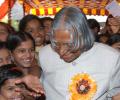
'President Kalam would always say -- this was one of his pet sentences -- that "If you don't do anything, there will be no difficulties but if you do things, there will be difficulties. You have to overcome them. Don't be afraid of difficulties".'

Former New Jersey Governor Chris Christie and a Republican presidential aspirant have called his fellow rival Indian-American Vivek Ramaswamy a guy who sounds like ChatGPT and described him as an "amateur" Barack Obama.

A report in today's Globe and Mail reveals that officials of the Canada's Atomic Energy Commission Ltd. spent 6 days in New Delhi during which they had a series of meetings with their counterparts in India's Department of Atomic Energy and the Nuclear Power Corporation of India Ltd. to see how AECL could re-enter the Indian market after Canada's embargo of almost 35 years in the nuclear field.
India on Tuesday banned exports and imports of all items from North Korea that can be used in nuclear or ballistic missile plans. The Commerce Ministry imposed a blanket ban on "all items, materials, equipment, goods and technologies which could contribute to the Democratic People's Republic of Korea's nuclear-related, ballistic missile-related and other weapons of mass destruction-related programmes".
Uncertainty over the Indo-US nuclear deal cast a shadow over the first Indo-French nuclear business meet in Mumbai, which was aimed at strengthening bilateral cooperation in the atomic field.
The US position is that cooperation on the construction of two new reactors, Chasma III and IV, would be inconsistent with the commitments China made at the time of its adherence to Nuclear Suppliers Group guidelines in 2004.

India and the United Kingdom are set to sign a "package of deliverables" during Prime Minister Narendra Modi's first visit here that will also see discussions over cooperation in sectors like nuclear energy and defence.
Signalling the continuity of policy, the new government has ratified the Additional Protocol, a commitment given under Indo-US nuclear deal by the previous dispensation to grant greater ease to International Atomic Energy Agency to monitor India's civilian atomic programme.
Foreign Secretary Shiv Shankar Menon said in New Delhi that, "Both India and Russia are keen to expand nuclear cooperation. All the preparatory work has been done." He was inaugurating an international conference on "Changing Patterns of Indo-Russian Cooperation" organised by the Observer Research Foundation. He said that India and Russia already have an "excellent relationship" and India considers relations with Russia very important.

T N Seshan believed that toughness at every level is needed to keep the flock under him strictly duty bound, recalls Dr K S Parthasarathy, former secretary, Atomic Energy Regulatory Board.
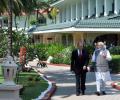
Big ticket defence deals including purchase of missile systems, frigates and joint production of helicopters were sealed on Saturday.

Macron held a tete-a-tete with Modi before the delegation-level talks at the Elysee Palace - the official residence of the French president.
Brazil and South Africa, key members of the Nuclear Suppliers Group, on Tuesday decided to explore ways for cooperation with India in civil nuclear field through "acceptable forward-looking approaches."
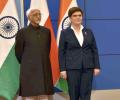
VP Ansari thanked Polish leadership for its support to India's bid for NSG membership,

"We are committed to building a new India. We have to do this as early as possible," he said.

In a country that is often focused on the ways in which it falls short, the start of a year is a good time to remind oneself of such positives, observes T N Ninan.
The agreements were signed after talks between Prime Minister Manmohan Singh and visiting French President Nicolas Sarkozy in New Delhi.

India and the United States must use energy and persistence to overcome the "obstacles" towards achieving the shared objectives agreed during the "transformative" visit of American President Barack Obama to New Delhi, US Ambassador Richard Verma said in New Delhi on Thursday.
The prime minister also talked about increasing the trade volume and transforming the nature of economic ties and expressed concern over religious extremism and terrorism in its neighbourhood.
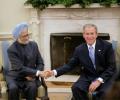
In the mid-1980s, India and the US struggled to arrive at sufficient confidence for Washington to even sell a supercomputer to India for monsoon prospecting. Now, the most sensitive military technologies, data, and intelligence resources are being shared. This would not have happened without that one, big deal that changed the fundamentals of India-US relations, notes Shekhar Gupta.

'This is the first time the US has formally recognised the threat India faces from terrorist organisations based in Pakistan.'
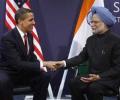
Implementation of civil nuclear cooperation and ways to expand cooperation in the fields of defence, security and economy will be high on the agenda when Prime Minister Manmohan Singh meets President Barack Obama in Washington next week.

Nehru's faith in science and technology, his genuine respect for Bhabha, and their burning ambition worked synergistically to place India on the nuclear map of the world. Atomic energy developed and prospered because of Nehru's vision fulfilled by Bhabha's mission, recalls K S Parthasarathy, former secretary of the Atomic Energy Regulatory Board, on the occasion of India's first prime minister's 119th birthday today.
Pakistan's Prime Minister Shaukat Aziz on Tuesday called for a "strong and vibrant" Pakistan-China economic partnership to promote comprehensive cooperation, especially in the field of nuclear power generation.
Officials and diplomats in Moscow said the two countries are expected to sign 8-10 agreements covering a wide spectrum of bilateral ties, including cooperation in civilian nuclear field, energy, space and defence.
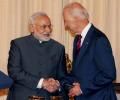
US-India defence cooperation must not adversely affect the India-Russia interface, which has its own strategic meaning and content, asserts Vice Admiral Premvir Das (retd).

Rediff.com's Sheela Bhatt, who is accompanying Prime Minister Manmohan Singh on his trips to Russia and China, notes that Moscow and New Delhi work together professionally and via a shared common approach on crucial issues.

Prime Minister Narendra Modi on Saturday arrived in Ulan Bator on his historic visit to Mongolia to hold talks with the country's leadership to bolster economic and trade cooperation, including in transport, highways and energy sectors.
Iran's top nuclear negotiator Ali Larijani held talks with External Affairs Minister Natwar Singh on Wednesday in New Delhi on strategic partnership, particularly in the field of energy.

'China might soon have to seriously consider whether it prefers an Indo-US hyphenation to a Sino-Indian one.'

The world's largest and most respected centre for scientific research has shown how collaborative effort in the acrimonious field of particle physics can prove of enormous benefit to mankind.

The US Government Accountability Office, in a recently released report, moved ONGC Videsh Ltd, the overseas arm of state explorer Oil and Natural Gas Corporation, and three others, including Petronet LNG Ltd, out of the list.

On Dr Homi J Bhabha's 110th birth anniversary, Dr K S Parthasarathy shares some personal memories of the legendary nuclear scientist.

DRDO's Air Independent Propulsion system will allow Indian Navy submarines to operate for up to two weeks without having to surface to recharge its batteries.

Prime Minister Narendra Modi will leave for the Belgian capital as part of a three-nation tour during which he will attend the Nuclear Security Summit in Washington and visit.

The growth story of India depends on its achievements in the S&T sector. There is a need to revolutionise the landscape of Indian science and technology and this is only possible if the scientific community is allowed to work 'professionally and scientifically' without burdening them with the baggage of the past, says Ajey Lele.

Sharif is accompanied by 11-member high-level delegation that includes senior ministers, Punjab and Balochistan Chief Ministers and top officials.

Russia and China have a broad consensus today on almost all core issues related to global strategic stability, which is unprecedented in modern history, observes Ambassador M K Bhadrakumar.
